
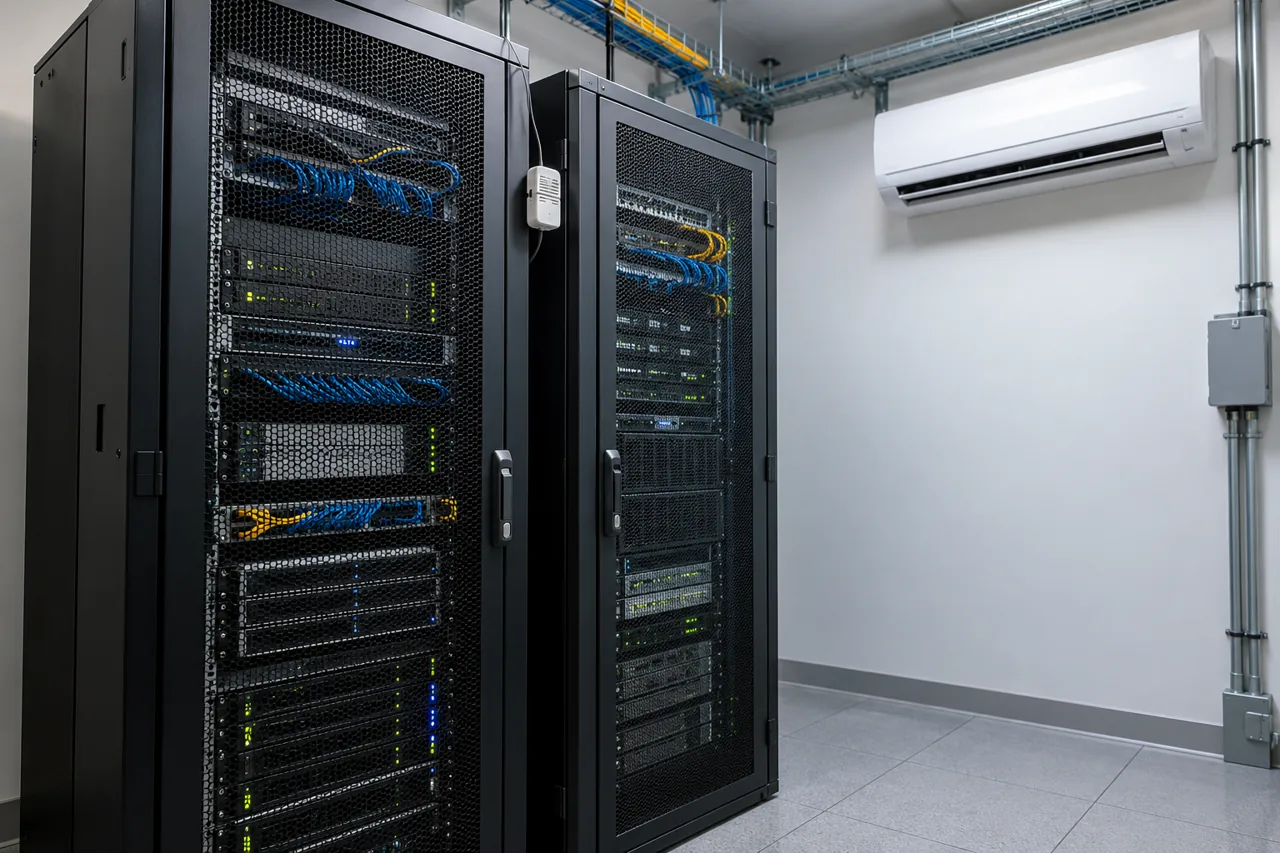
Detect problems before they interrupt your business
An overheating rack, a leaking air conditioner or a UPS running down often starts with one signal. We bring these signals together to identify the location and notify the responsible person. We cover small server rooms, IT cabinets, branch offices and larger IT installations. The scope follows service criticality and duty arrangements.
The service includes sensor selection, installation, dashboard configuration, tests and operating instructions. Choose monitoring alone, integration of existing equipment or implementation with ongoing maintenance. Hardware, installation, communications and support are itemised separately.
What we measure and where sensors go
We monitor temperature at equipment air inlets, selected rack heights and locations at risk of overheating. A single wall sensor may miss local hot spots. Positions depend on racks, airflow, load and cooling arrangements.
Options include relative humidity, dew point, water leaks, doors, cooling, UPS, PDU, mains and generator status. Leak detection accounts for raised floors, condensate and pipe routes. Fire signals require an appropriate interface; technical monitoring does not replace the fire alarm system.
Standards and guidance matched to the site
References include the PN-EN 50600 series, particularly Part 2-3 on environmental control, and ASHRAE TC 9.9 guidance. Applicable editions and scope are defined in the project. Sensors alone do not award an availability class or certification to an entire data centre.
ASHRAE recommends 18–27°C at equipment air inlets for classes A1–A4, subject to conditions of application. This is not a universal legal limit or a ready-made alarm threshold. Manufacturer limits, humidity, dew point and rate of change matter. Building, electrical and fire requirements are assessed separately. Polish project references in this English version do not establish compliance with UK law.
Alerts and responsibility for response
The design defines warning and critical thresholds, hysteresis, delays and recipients. Alerts should identify the site, rack, parameter, value and event time. Missing data, faulty sensors and loss of monitoring power require distinct messages.
SMS, email, duty arrangements and any escalation are agreed in scope. Acceptance tests check the path from a signal to the recipient. Delivery also depends on connectivity and carriers. Continuous recording does not automatically include a staffed 24-hour response service; support hours and response commitments are contractual.
DATPOL Control: readings, history and control
The dashboard can present sites, timestamped readings, trends, alarms and reports. Permissions limit access to assigned locations. Sampling, aggregation, retention and export are agreed before commissioning. We integrate available SNMP, Modbus, MQTT or API interfaces after checking equipment models.
Control also supports agreed device operations, requiring separate permissions, state confirmation and failure behaviour. Local cooling and safety functions retain their required operation without the online dashboard. Environmental monitoring can be combined with energy measurement and assessment of installation performance.
Recording continuity and controlled access
Where justified by risk, we specify local buffering, backed-up power and secondary connectivity. Recovered measurements should retain their original timestamps and gaps remain visible. These functions require suitable hardware and acceptance tests.
Network segmentation, individual accounts, restricted privileges and controlled service access reduce exposure. Sensors need not be publicly accessible from the Internet. Configuration backups, updates and responsibility for connectivity are agreed in advance.
Design, installation, acceptance and maintenance
We survey racks, cooling, power and existing alarms, then prepare a point schedule, communication diagram, notification matrix and quotation. Installation includes labelling, dashboard commissioning and operator training. Agreed acceptance tests cover thresholds, connectivity loss, power failure and recovery.
Handover includes equipment records, settings, test results and operating instructions. Maintenance may cover probes, batteries, alarm tests, calibration as required, updates and replacements. Changes take place during agreed maintenance windows.
Choose a scope and request a quotation
Basic monitoring covers temperature, humidity, history and alerts. Technical supervision adds leaks, doors, UPS, cooling and communications. Multi-site coverage provides a shared dashboard, access separation, reporting and agreed support.
Send the number of sites and racks, UPS and cooling models, connectivity, locations and response requirements. We will propose stages, acceptance criteria and running costs. Suitable existing infrastructure can be retained and integrated.
Frequently asked questions
Can existing equipment be used?
Yes, subject to measurement range, documentation and interface checks. Compatibility and integration scope are confirmed before quotation.
What is needed for a quotation?
Point and site quantities, equipment models, required parameters, connectivity and documentation and support requirements.
Does the service include a staffed 24-hour response?
Only if agreed contractually. Recording, notifications and a staffed response are separate service scopes.
Sources and scope
Sources reviewed on 12 October 2026. Applicability and editions are confirmed for the specific project.