
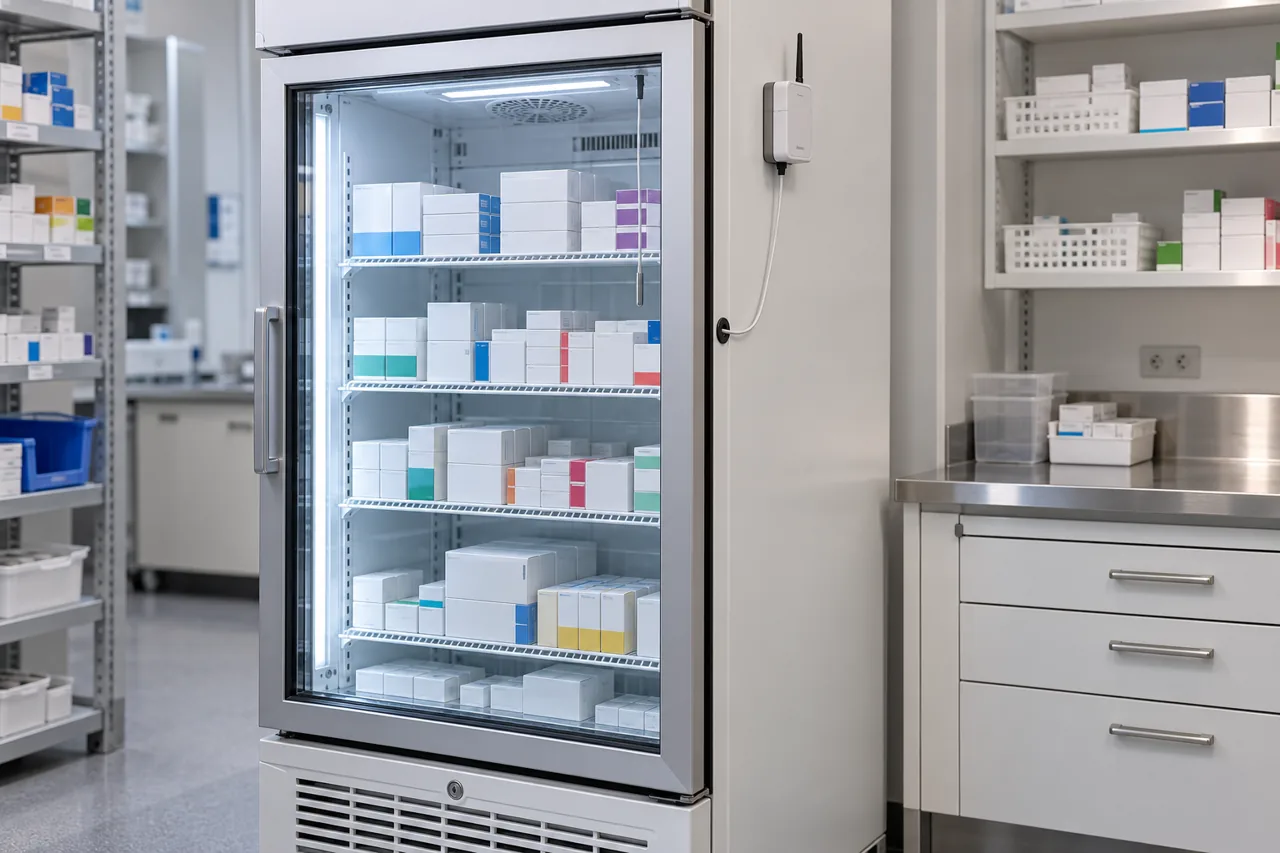
Protect storage conditions outside opening hours
Refrigeration failure, an open door or a power cut needs prompt detection. We provide monitoring for pharmacies, clinics, vaccination sites, hospital pharmacies and pharmaceutical cold stores. Requirements are assessed separately for each establishment, activity and product.
The service combines probes, recording, notifications and reports with installation, testing and staff training. Data supports excursion assessment. The system does not automatically decide whether a medicine remains suitable or replace the person responsible for quality.
Medicines and HACCP require different approaches
HACCP concerns food safety. It is not a standalone framework for medicine-storage compliance. Medicinal products require manufacturer conditions, product documentation, applicable establishment rules and procedures. GDP applies to activities within its scope, particularly wholesale distribution.
If the site also has a kitchen or food store, we specify separate monitoring points, thresholds and HACCP-supporting records. A common dashboard can serve both while responsibilities and reports remain distinct.
Current Polish pharmacy requirements
The Polish amendment of 17 November 2025 requires equipment with a calibration certificate in pharmacy refrigeration, capable of reading minimum and maximum temperatures between readings. It also addresses control records and excursion handling, with an adjustment deadline of 3 March 2026.
We do not advertise round-the-clock temperature and humidity monitoring throughout every pharmacy as a universal requirement of this amendment. Automated recording and alerts are risk-based enhancements. These are Polish rules; this English version does not claim compliance with UK pharmacy law. The legal source is linked below.
Storage temperatures follow the product
Some refrigerated products require +2°C to +8°C, but this range does not apply to all medicines. The responsible person approves thresholds using product documentation. Excessive cold and freezing can be as significant as overheating.
Selection covers probe range, measurement uncertainty, resolution, response and position. Air temperature is distinguished from product temperature. Buffered probes need a rationale and must not conceal significant excursions. Humidity is monitored where required by the product, process or risk assessment.
Mapping, calibration and quality documentation
For GDP activities, the scope accounts for initial storage-area mapping and sensor locations based on its findings. Repeat assessments and calibration intervals follow risk and changes to the installation. Details are agreed with the client’s quality system.
Test plans define points, duration, scenarios, loading, door-opening and power-loss tests, including seasonal factors where relevant. We select measurement chains with calibration documentation, confirming accredited laboratory requirements and scope where needed. IQ/OQ/PQ and computerised system validation are separately defined services if required.
Notifications that support action
We establish thresholds, delays, hysteresis, recipients and response arrangements. Door opening, power loss and probe faults can be included. Missing readings have a separate status; an old value is not presented as current.
SMS and email are configured and tested with recipients. Local memory, backed-up power and secondary connectivity require suitable equipment. Escalation and duty arrangements are specified in the order. Immediate delivery cannot be promised when every communication path is unavailable.
History, minima, maxima and DATPOL Control reports
The scope can include current readings, point histories, minima and maxima and report exports. Sampling, retention, document formats and gap indicators are agreed. Users receive access only to assigned sites and devices.
Quality documentation requires agreed device identification, timestamps, completeness, excursions and links to recorded actions. Audit trails, electronic signatures, immutable records and validation require separate functional confirmation. A standard PDF is not automatically a validated GDP record. Decisions about further product use remain with authorised personnel.
Survey, commissioning and ongoing support
We assess requirements, select probes, install without unapproved changes to refrigeration enclosures and configure connectivity, dashboards and alerts. Acceptance checks cover agreed readings, notifications, connection loss and recovery. Handover includes a sensor register, calibration documents, commissioning records and operating instructions.
Support can cover tests, batteries, calibration arrangements, replacement equipment and updates. Send refrigerator or cold-room quantities, temperatures, establishment type, locations and quality requirements. Hardware, installation, quality documentation, connectivity, SMS and maintenance are quoted separately.
Frequently asked questions
Can existing equipment be used?
Yes, subject to measurement range, documentation and interface checks. Compatibility and integration scope are confirmed before quotation.
What is needed for a quotation?
Point and site quantities, equipment models, required parameters, connectivity and documentation and support requirements.
Does the service include a staffed 24-hour response?
Only if agreed contractually. Recording, notifications and a staffed response are separate service scopes.
Sources and scope
Sources reviewed on 12 October 2026. Applicability and editions are confirmed for the specific project.