Different manufacturers. One view.
Your meter. Your sensor.
Our integration.
Tell us what you have. We assess the integration of any type of meter or sensor — from new equipment to existing installations. Where an accessible reading or interface is available, we connect it to a shared monitoring system.
Discuss your deviceModbus · MQTT · API
Modbus RTU/TCP, MQTT, pulse outputs, analogue signals and software APIs. We select gateways, signal conversion and software integration for the application. We check the model, protocol, access permissions and data quality before confirming compatibility.
Connectivity that fits your building
With cables. Without cables.
With room to grow.
A new installation or a building already in use? We select wired connections, wireless LoRaWAN or a combination of both. Your measurement points share one view, even when they use different technologies.
01 / WIRED
Reliable connections where you need them
We connect compatible meters and sensors using RS485 / Modbus, pulse outputs and analogue signals. We assess existing cabling and design new routes where required.
↗ A practical choice where cable routes and power are available.
Plant rooms · switchboards · industrial installations
02 / LoRaWAN
More measurements. Less new cabling.
Wireless LoRaWAN sensors send readings to a gateway, which forwards them to the monitoring system. Suitable battery-powered devices help add measurement points without running a power cable to each sensor.
↗ Add temperature, humidity, meter readings or contact states with compatible equipment.
Warehouses · rented premises · dispersed measurement points
03 / HYBRID
Different connections. One system.
Keep wired energy meters and add wireless environmental sensors. We combine compatible sources in a shared view with history, reports and agreed alert rules.
↗ Start with the most important points and expand as your needs grow.
One building · several sites · phased extensions
We check the site, not just the specification.
Before deployment, we check radio coverage, sensor placement and gateway locations. Walls, metal enclosures and refrigeration equipment affect the signal. We select external probes or a different connection where needed. Reporting intervals and battery life depend on the equipment and application.
From a reading to a useful response
We agree thresholds, recipients and reporting schedules. Depending on the equipment, the system can also flag missing readings or low batteries. The gateway needs a connection to the server, for example through Ethernet or mobile data; LoRaWAN sensors do not each need a SIM card.
From sensor to decision
More than
a box of hardware.
We agree what to measure, where and why. The service can include installation, a data view, notifications, reports and ongoing support.
01 / DATPOLUnderstand the site
Agree measurement points, required accuracy and available connectivity.
02 / DATPOLSelect and install
Connect sensors, meters and data collection equipment. Check readings during commissioning.
03 / DATPOLSet the rules
Define thresholds, delay, recipients and notification channels. Alerts should support a useful response.
04 / DATPOLMake data usable
Provide a view, history and agreed reports. A support arrangement can help keep the system running.
People behind the measurements
Technology backed
by the DATPOL Group.
We bring together electrical installation, automation, refrigeration and IT. Measurement becomes part of a practical site solution, from sensor power to data access.
The scope follows your business needs. Start with a few measurement points and expand as more units or processes become relevant.
Meet DATPOL
The right sensor in the right placeSelect measurement range, accuracy and environmental suitability. Calibration requirements are agreed for the application.
Access according to responsibilitiesDesign user and site separation. Connectivity and security controls follow the deployment architecture.
Alerts matched to the processEmail alerts, with SMS available in an agreed configuration. Consider delays, schedules and responsible recipients.
Before we begin
Can you use our existing meters?
Often, yes. We first check the model, interfaces or protocol, reading permissions and data quality before confirming compatibility.
Will I receive a message when the temperature exceeds a limit?
Yes, where notifications are included in the scope. We agree the threshold, exceedance duration and recipients. Delivery time also depends on connectivity and the messaging provider.
What happens if the Internet connection fails?
Buffering and recovery depend on the selected equipment and are agreed before deployment. A missing reading should be shown as missing data, not as a normal value.
Does monitoring automatically ensure regulatory compliance?
A sensor alone does not ensure compliance. The solution must match the intended use, accuracy, documentation and site procedures. Applicable requirements and calibration are agreed before commissioning.
Does the whole installation need replacing?
Not necessarily. After assessing the site, we propose retaining suitable infrastructure and adding the missing components.
Monitoring for critical environments
Server room monitoring: temperature, humidity and alarmsServer room and IT rack monitoring: temperature, humidity, leaks, UPS and cooling. Design, installation, alerts and maintenance with DATPOL Control.Temperature monitoring for medicines, pharmacies and cold storesMedicine refrigerator and pharmaceutical cold-store monitoring: calibration, min/max readings, alerts, history and reports. Design, installation and support. Your measurements in your own system
DATPOL can issue an individual, read-only API key for your assigned devices. Retrieve current readings, measurement quality and history over HTTPS in JSON format. Keys have an expiry date and can be revoked independently. Your account permissions also apply to API access.
API documentation and curl / Python examples
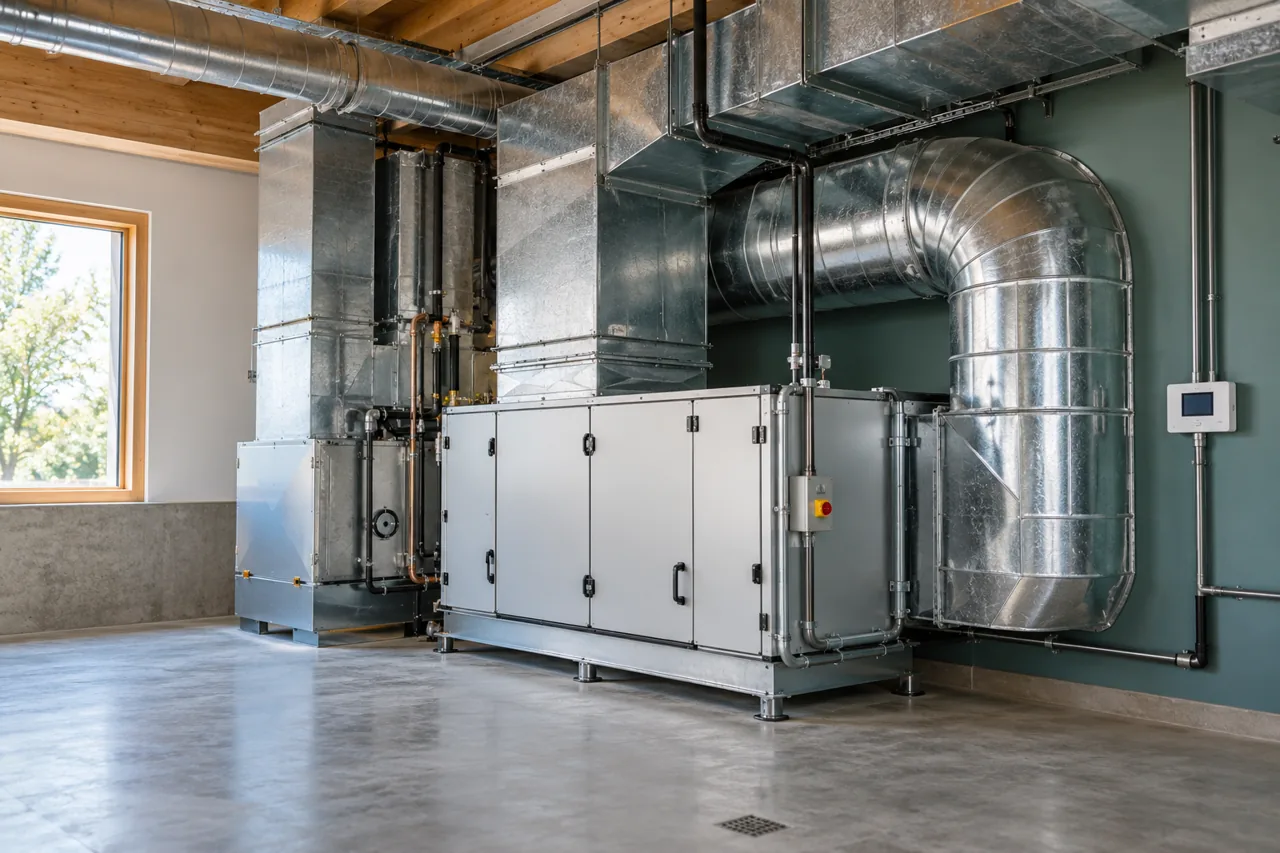
Ventilation and heat recovery connected through BACnet
We can integrate compatible air handling units, heat recovery ventilation and air conditioning through BACnet/IP or a suitable BACnet MS/TP gateway. The available scope can include temperatures, fan operation, filter alarms, operating modes and supported setpoints.
Before commissioning we verify the controller object list, read/write permissions and manufacturer limits. Home Assistant owns the automation; Control provides the view and authorised buttons. A sent command is confirmed only when feedback is available.
Discuss your installation