Homes and smaller sites
Use your solar generation, preserve battery reserve, manage hot water and heat pumps, and prepare your car for departure. Priorities reflect comfort and your energy contract.

Design · Installation · Integration · Commissioning · Support
We bring metering, solar PV, battery storage, EV charging and heating into an agreed energy plan. We start with your installation and operating needs, select suitable equipment and commission automation with installer support.
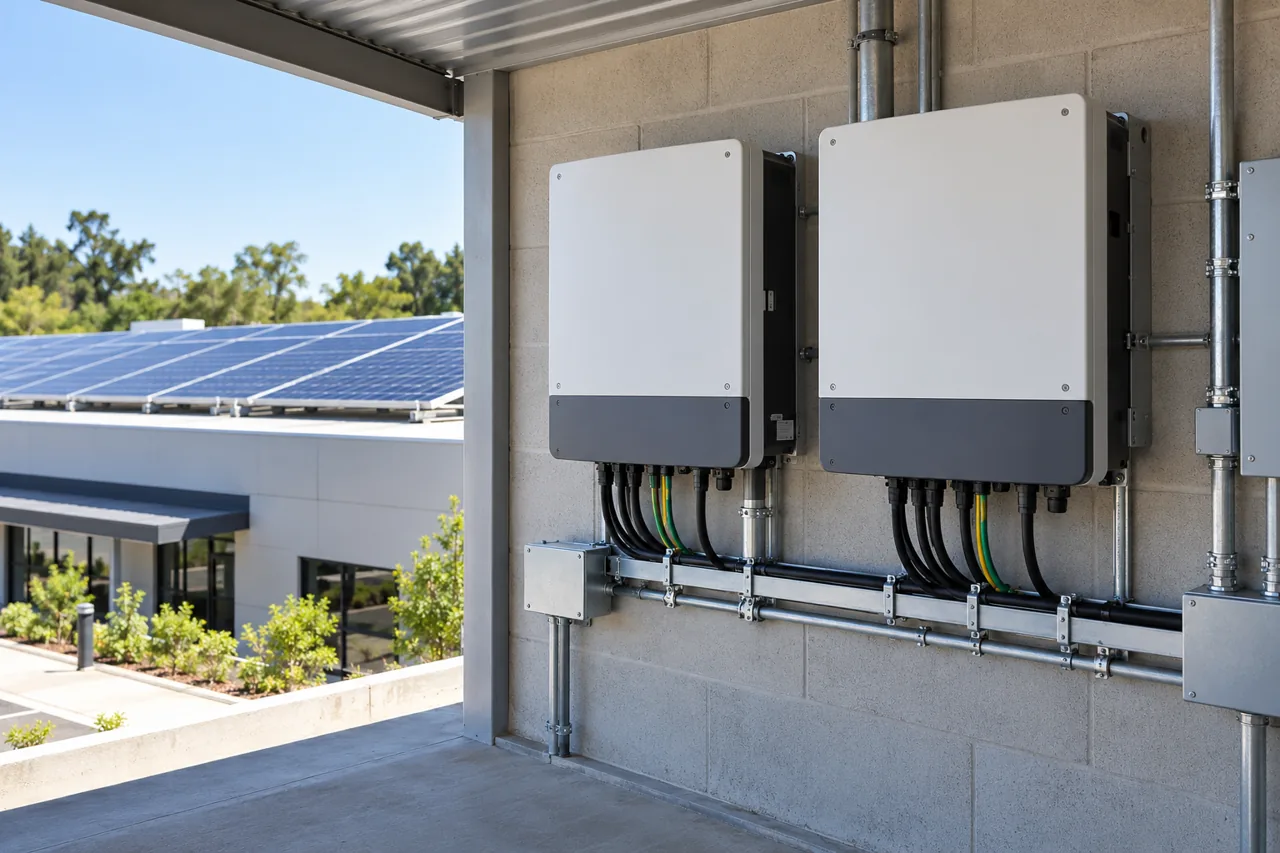
DATPOL EMS with installer support
Home Assistant owns the logic and automation. DATPOL Control provides the interface, permissions and reports. Read and control capabilities are verified for the specific device model, firmware and installation.
Use your solar generation, preserve battery reserve, manage hot water and heat pumps, and prepare your car for departure. Priorities reflect comfort and your energy contract.
Connection limits, demand peaks, production hours, cooling and charging. Optimisation respects operational continuity and process constraints.
Schools, municipal sites and multiple supply points in one interface. Schedules, site-specific access and reports to support budgets and investment reviews.
Energy balance, self-consumption, battery selection, reserve and an agreed scope for charging and export management.
Import and export prices are considered separately, with the contract formula, efficiency, battery wear and charges.
Integration of compatible OCPP chargers, power limits and charging targets. Protocol versions and functions are tested on the device.
Hot water, thermal stores, heat pumps and flexible equipment. Relays, contactors or power controllers are selected for the load and its protection.
Phase measurements, alerts and designed load responses. An EMS supports energy management and does not replace electrical protection.
Cold stores, hotels, farms, water utilities and critical infrastructure need their own design and process priorities.
Start with monitoring and simulation, then expand automation in stages. Where offline operation is required, we specify a local Home Assistant controller and test loss-of-connectivity behaviour.
Each project has its own supported-device list and acceptance tests. We do not promise the same savings percentage or payback for every site. A full shared optimiser, demand-response or VPP services and bidirectional charging require separate technical and market qualification.
Send an energy bill, the inverter, battery and charger models, and your objective. We will propose a metering, pilot and expansion scope. Market rules and requirements are checked for the project location.
Choose your application
Schools, offices, sports facilities and municipal services in one agreed measurement structure. A portfolio view for the coordinator and access to the relevant building for each site manager.
Start with representative sites, bills, supply-point details and operating hours. Define responsibility for each building, reporting needs and access scopes. Compare similar buildings and allow for weather, occupancy and data gaps.
Read the implementation checklist in the wikiIdentify where energy goes: processes, refrigeration, compressed air, offices and tenants. Relate consumption to production and operating hours.
Start with the main meter and the loads that matter to your process. Define useful metrics such as kWh per tonne, per item or per operating hour. Separate network operator, energy supplier and the actual contract when estimating costs.
Read the implementation checklist in the wikiThe quotation separates equipment, installation, integration, optional control and ongoing support. Battery optimisation starts with simulation; live control depends on the actual inverter, storage and operating limits.
An Energy Monitoring System collects data about consumption, generation and energy flows. Instead of reviewing bills, inverter applications and meter readings separately, you gain a shared view of the site. Opomiarowani scopes range from readings and reports to agreed automation integration. Energy Management System describes wider management, potentially including control rules. Control functions are commissioned separately after equipment, process constraints and permissions have been checked. This service describes deployment options, not an identical feature set available at every site.
The greatest value comes when data informs an available decision. A factory can assess energy per shift or unit produced. A water utility can compare kWh per cubic metre pumped. Hotels can relate use to occupancy, and office managers to opening hours. Cold stores, farms and shops can analyse continuously operating equipment. Municipalities can compare schools, offices, sports facilities and lighting. Access is scoped to responsibilities; tenant energy statements can be linked with Podlicznik.
kW describes instantaneous or interval-average power; kWh is energy used over time. We record import and export, active power and, with suitable analysers, reactive and apparent power, power factor, voltage, current and phase parameters. Data helps identify demand peaks, imbalance and deviations to investigate. Power-quality analysis, such as harmonics, requires appropriate instruments and recording settings. A basic kWh meter cannot replace a power-quality analyser. Gas, heat, water and environmental readings can extend the picture.
PV generation alone does not show the full benefit. Inverter data is combined with supply-point and load measurements to separate on-site use, import and export. Self-consumption measures how much generation is used locally; self-sufficiency measures how much demand is met locally. With storage, flow directions must be considered to prevent double counting. Reports can identify loads suitable for moving into production periods, such as vehicle charging, hot-water preparation or permitted process cycles. Process reserves and user comfort remain overriding constraints.
Depending on BMS and inverter interfaces, we analyse state of charge, available power, energy flows, temperature and limitation signals. A strategy may combine greater self-consumption, reduced demand peaks and a backup reserve. Nominal and usable capacity must be distinguished, with efficiency, charging power, SOC limits and warranty conditions included. An EMS cannot create backup capability if the electrical arrangement and inverter do not provide it. Control commands must respect the BMS, manufacturer protections and critical-load priorities.
The market price is only one part of the calculation. We assess the actual contract formula, supplier margin, variable charges, export rules and settlement intervals. Storage adds losses and battery wear costs. A negative market price does not automatically mean a negative bill. Planning may use PV and load forecasts and available prices, but forecasts remain distinct from measurements. Automatic load shifting or charging requires accessible interfaces, approved rules and defined behaviour when prices or connectivity are unavailable. Without control, the system can still provide recommendations and scenario comparisons.
Simultaneous starts of large loads can create a peak hidden in monthly kWh totals. We analyse load over the intervals relevant to the contract and identify possible equipment sequencing. Peak reduction is useful where the process, storage and billing arrangements allow it. Reactive-energy recording helps assess charges and the need for a compensation study. An EMS does not itself compensate reactive power. Compensation equipment requires assessment of loads, harmonics and installation conditions. Not every instantaneous rise creates a billable exceedance.
A hydrogen project benefits from comparing electrolyser input, auxiliaries and compressor use, hydrogen production and energy recovered through a fuel cell. kWh/kg, operating time, availability and conversion losses can be assessed where the installation exposes suitable data. Tank pressure alone is insufficient for an accurate inventory without a model accounting for temperature and gas properties. Hydrogen integration is individually scoped with the designer and technology supplier. An EMS may receive status signals but does not replace hydrogen detection, ventilation, safety interlocks or safety controllers.
Compatible sources are connected through Modbus RTU/TCP, pulses, documented APIs and MQTT. LoRaWAN can support periodic readings from dispersed points; it is not the basis for fast control loops or safety functions. Each point needs units, scaling, flow direction, timestamps and quality information. Cumulative kWh readings are differenced over time; power is integrated only with adequate sample quality. Meter replacement, resets, gaps and delayed data must be handled. Local buffering and history recovery depend on equipment and the agreed architecture.
Useful rules include after-hours consumption, communication loss, reversed energy flow, balance deviations and equipment limitations. Thresholds, delays and recipients follow the process. Integration starts with read access; writes require separate permissions, an allowed-command list and acceptance tests. Design can include OT/IT segmentation, encrypted channels, action logs, least privilege and update procedures. Cloud failure must not remove local protection. Public access to inverter or BMS control registers is not part of the design.
There is no universal requirement for every business with PV to buy an EMS. Duties depend on the organisation, energy use, property and project conditions. Measurements support energy audits and investment evaluation. ISO 50001 also covers responsibilities, objectives and improvement; a dashboard does not establish certification. Article 11 of EU Directive 2023/1791 distinguishes above 85 TJ for an energy management system and above 10 TJ for audits, using three-year average annual consumption across all energy carriers. These are EU-level provisions; applicability, deadlines and Polish implementing law require organisation-specific checking. This English version describes the Polish service context, not UK compliance. Sources appear below.
Hydrogen requires a separate hazard assessment, suitable equipment for classified areas and review of pressure-equipment and inspection requirements. A process-system reading does not replace required protections. Likewise, energy monitoring does not replace the operator’s settlement meter; billing use requires checking applicable metrological requirements. Connection conditions, export limits, funding terms or contracts may impose further recording duties. The proposal distinguishes operational indications from measurements intended for documentation or settlement.
First establish a baseline: use, cost, working hours, production, weather and site changes. After deployment, compare equivalent conditions rather than merely two bills. Lower kWh may reflect reduced production rather than improved efficiency. Assess integration and support costs, storage losses and equipment life. Useful indicators include kWh/m², kWh per production unit, period cost, overnight demand and the local-energy share. An EMS helps identify and measure improvements; it does not guarantee a savings percentage without data analysis.
1. Inventory meters, PV, storage, tariffs and loads. 2. Design measurement points and secure communication. 3. Commission readings and compare them with equipment. 4. Establish a baseline, indicators and alerts. 5. Evaluate operational changes and their economics. 6. Add optional control after agreeing priorities, limits and tests. 7. Review outcomes and maintain the system. For an initial discussion, provide bills and a load profile, inverter and storage models, an installation diagram and working hours. DATPOL will scope integration and quote for the particular site.
No. It requires a compatible interface, control authorisation and a design respecting the BMS, warranty and installation limits. Monitoring can be the first stage.
No. Results depend on the load profile, contract, charges and ability to shift demand. An EMS allows scenarios to be compared using data.
We assess models, protocols, data access and permissions. Integration is confirmed after checking, separately for reading and control.
We monitor mains supplies, automatic transfer switches and generators: power availability, source changeovers, operating parameters, alarms and event history.
Combine energy analysis with source availability and standby-power event history.
Explore the serviceIllustrative assumptions: buy 100 kWh at a variable import cost of PLN 0.40/kWh; with 90% round-trip efficiency, discharge 90 kWh to replace imports at PLN 0.90/kWh. Avoided expenditure is PLN 81 and charging cost is PLN 40. Subtract an assumed PLN 5 cycle-wear cost: the illustrative contribution is PLN 36 for this cycle. It excludes investment, fixed charges and taxes; values are assumptions, not a price forecast or a return guarantee. The displaced demand must actually exist, and export alternatives can change the result.
Technical and regulatory references reviewed on 6 October 2026. Current applicability is checked when scoping a deployment; the Polish consolidated text is not a substitute for checking subsequent amendments.
Read the full EMS knowledge base guide: calculations, commissioning and troubleshooting
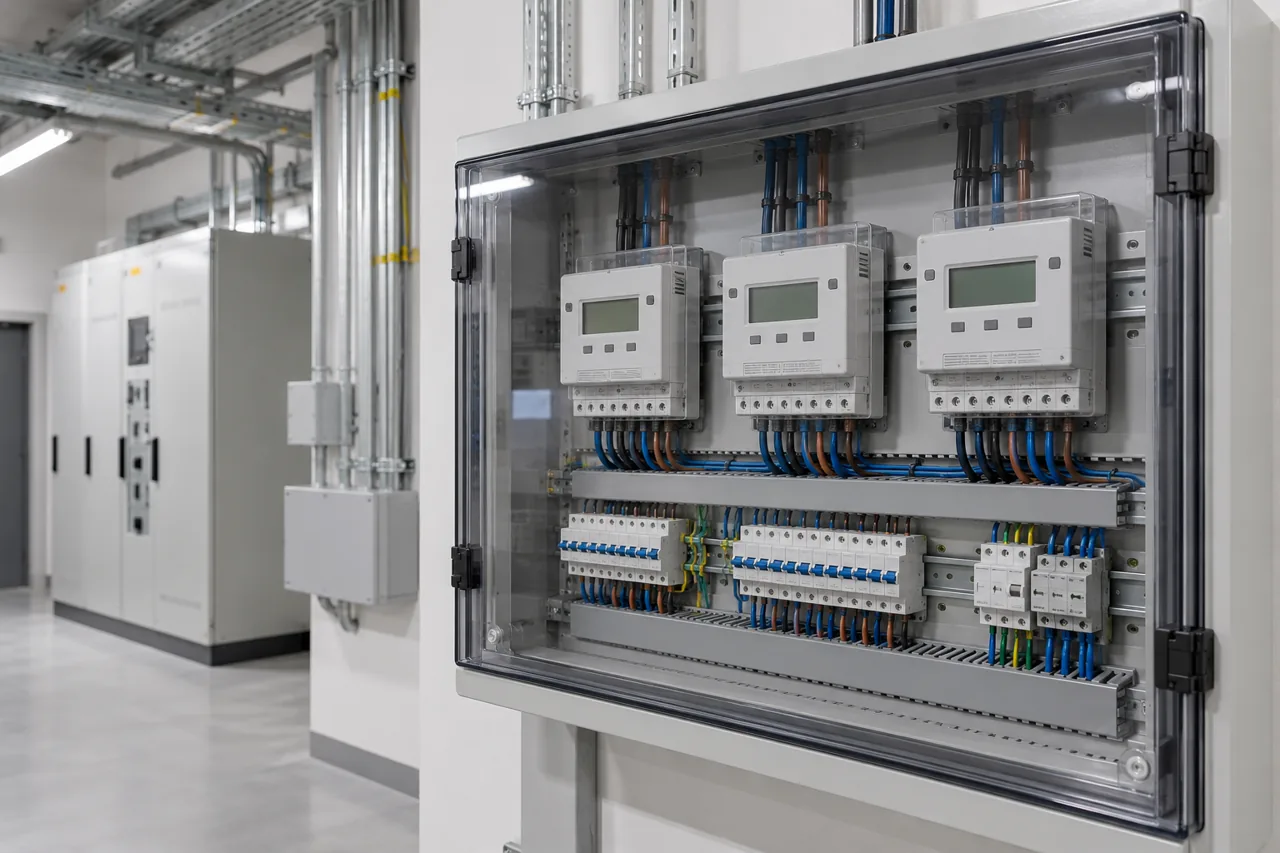 Podlicznik — metering and tenant billingRemote readings, consumption history and clear reports.Explore the service